
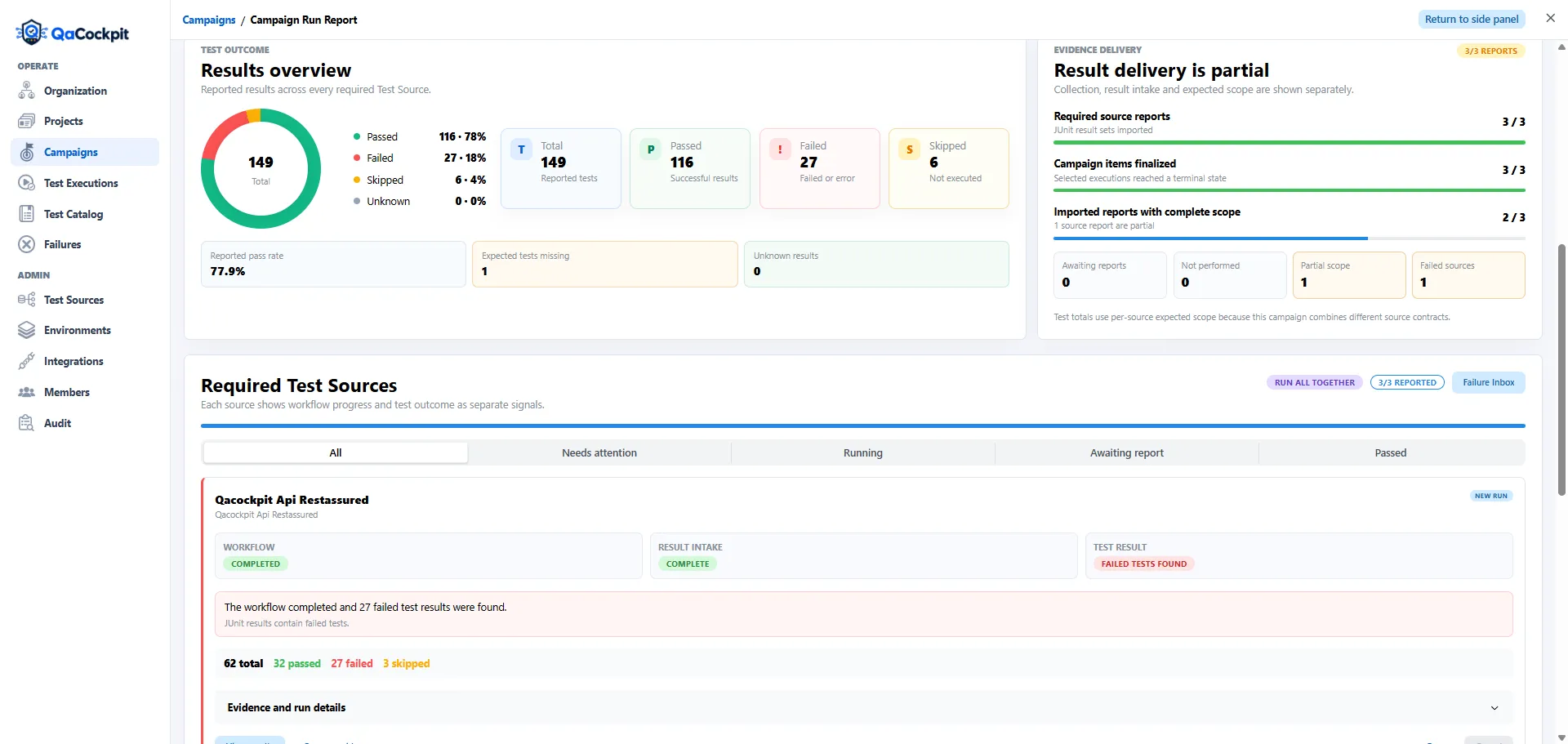
The release channel says that a pipeline is red. That sounds urgent, but it is not yet a release decision.
Did the application fail to build? Did a deployment step lose access to an environment? Did 27 automated tests fail? Did the tests finish but their report never reach the place where the team reviews it? And while one team investigates that pipeline, have the UI, API, mobile, integration, and unit-test pipelines owned by the other teams all reported?
Software is ready to ship when the team has complete, current, and traceable evidence from every release-critical source, and the remaining failures and unknowns are understood and explicitly accepted. A ticket status, one pipeline color, or one pass-rate percentage cannot establish that on its own.
A red pipeline is an event, not an explanation
Red can mean several different things:
- the code did not compile;
- the deployment failed before tests could start;
- the test runner or environment failed;
- the tests ran and found product failures;
- the pipeline was canceled or timed out;
- the tests completed, but the structured result report is missing.
Those conditions do not carry the same release risk or require the same owner. A failed
deployment may need DevOps. A failed assertion may need a product team. A missing report
may be a test-infrastructure problem. Treating all three as Pipeline failed creates a
queue of questions instead of a shared picture.
Green is not sufficient either. A pipeline can pass after running only part of its expected suite. It can also be a deployment-only pipeline that never claimed to validate the product.
The first rule of release readiness is therefore simple:
Keep pipeline lifecycle, deployment outcome, result intake, and test outcome separate.
Start with an evidence map, not a dashboard
Before asking whether a release is ready, identify which sources are expected to answer that question. In a larger product, one release may depend on several teams and many technical flows:
| Release evidence source | Typical owner | What it should prove |
|---|---|---|
| Backend unit tests | Development team | The changed code satisfies fast component-level checks |
| API regression | QA or service team | Critical service behavior still works across the target environment |
| Browser regression | QA or frontend team | Important user journeys work in supported browsers |
| Integration or contract tests | Platform and service teams | Boundaries between systems remain compatible |
| Deployment verification | DevOps or platform team | The intended build reached the intended environment |
| Mobile or specialist suites | Owning product team | Release-specific channels and capabilities were covered |
Not every pipeline in the organization belongs in every release decision. A documentation build, an unrelated branch validation, or an optional nightly experiment should not block shipping. The useful distinction is between required evidence, supporting evidence, and unrelated automation.
This definition needs to exist before the release meeting. Otherwise the QA Lead or Test Manager discovers the scope by asking people which pipelines they remember running.
Before your next release discussion, take the free Release Visibility Check to identify where your evidence is clear and where information is still missing. Your score and practical next steps are available without an account or email.
The seven-question release readiness checklist
1. Did every required source participate?
Count required Test Sources, not just finished jobs. If the UI team, API team, and payments team each own separate automation, the release view must show whether every required source contributed evidence.
No report is not the same as Passed. Not run is not the same as Failed. Both are
explicit states that need an owner and a next action.
2. Does the evidence describe the release candidate?
Verify the branch or ref, commit, build, environment, provider run, attempt, and timestamps. A perfect regression result from yesterday’s commit or the wrong environment is useful history, but weak evidence for today’s release.
3. What happened to the pipeline itself?
Record whether each required workflow started, completed, failed to start, timed out, or was canceled. This explains whether the expected validation process ran at all. It still does not answer what the tests found.
4. Did a usable test report arrive?
A completed CI/CD job may contain no JUnit file, an empty report, or an artifact that was never retained after a failed test command. Result intake deserves its own signal because silence must never be interpreted as success.
5. Did the expected test scope report?
Compare exact test identities, required suites, shards, and sources with the accepted baseline. A report containing 620 passing tests is incomplete if the release expected 800. Pass rate describes the observed results; scope completeness describes whether the observation was sufficient.
6. Can the team understand current failures?
A useful readiness review distinguishes new, awaiting investigation failures from known risks, investigations in progress, and issues waiting for verification. Each relevant failure should lead to its test, source, execution, error context, logs, and artifacts.
The standard is not that every failure has disappeared. The standard is that no important failure remains invisible or unexplained.
7. Who accepts the remaining risk?
QaCockpit Cloud presents a release readiness advisory; it does not approve a release on behalf of the team. If a known failure is accepted, preserve who made that decision, what evidence they reviewed, and which release context it applied to.
Where Jira and other management tools fit
Jira, Azure Boards, test-management products, and established ALM tools can organize delivery work, defects, manual testing, ownership, and release versions. That is valuable context. Atlassian’s own description of the Jira Release Hub focuses on work items plus development signals such as commits, pull requests, and builds.
The automation question is different: did every required test pipeline run, did its exact
results arrive, did the expected scope report, and can the team inspect the failure
evidence? A work item marked Done and a build marked Succeeded do not automatically
answer those questions.
The systems should complement each other. Work tracking explains what the organization planned and who owns the work. Cross-source test evidence explains what the release candidate actually demonstrated.
Replace the status chase with one cross-team review
Without a shared evidence model, a readiness review often becomes a sequence of messages:
- “Did the API regression finish?”
- “Which UI pipeline should I open?”
- “Was that red run a deployment failure or failed tests?”
- “Did the mobile team run against this build?”
- “Where is the screenshot from the failed checkout test?”
The answers may exist, but they are distributed across people, pipeline pages, artifact archives, and local knowledge. The QA Lead becomes a human integration layer.
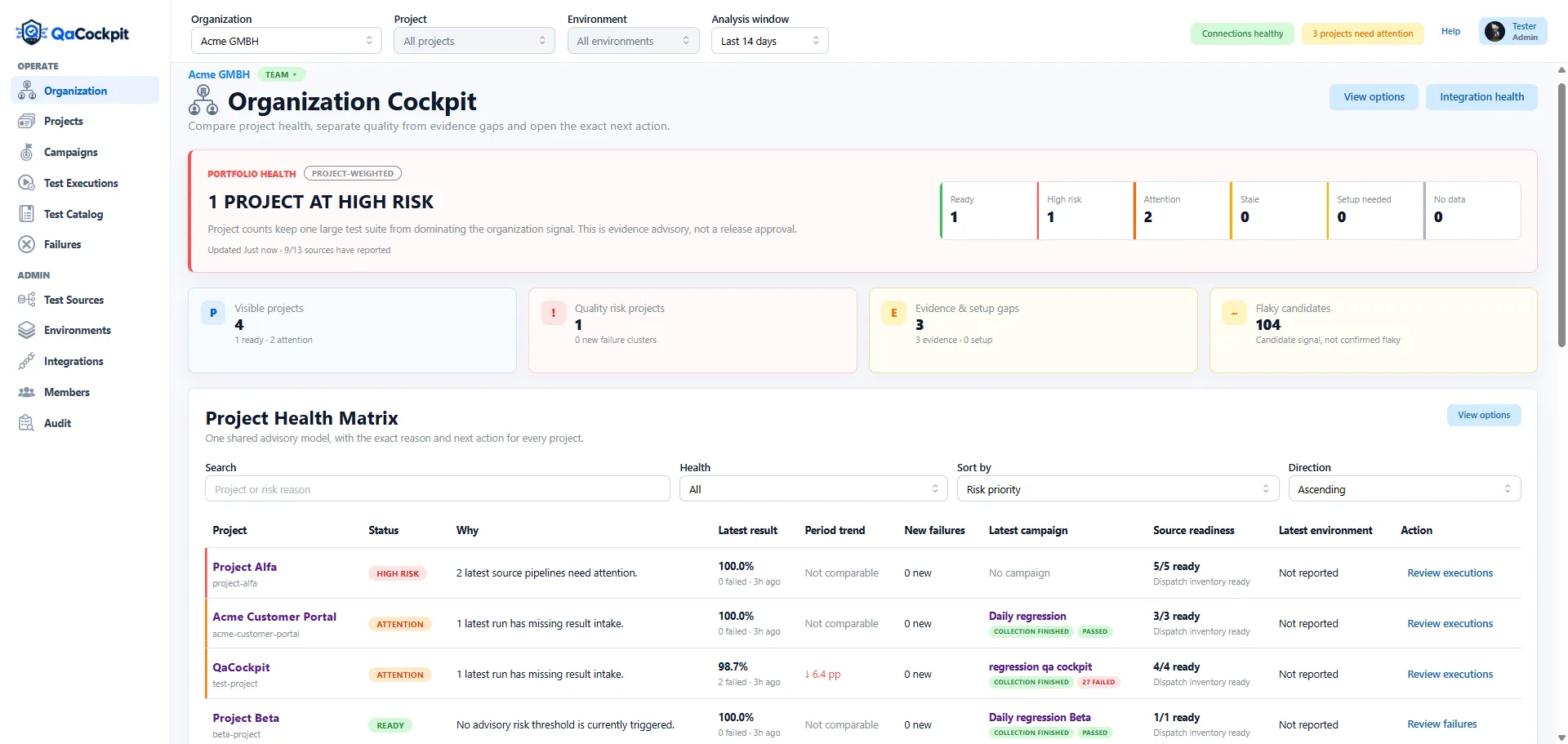
A portfolio view should preserve the reason behind every project state instead of averaging all test cases into one reassuring percentage.
A stronger process gives every required source a visible place in the release collection. It keeps collection status, pipeline state, result intake, test outcome, scope, and failure understanding separate, then connects each warning to the exact evidence and next action.
That does not remove human judgment. It removes the manual search required before people can apply judgment.
Ready to ship is an evidence-backed decision
The final question is not “Are all pipelines green?” It is:
Has every required team supplied enough current evidence to understand what was tested, what was not tested, what failed, and what risk remains?
When the answer is visible in one review, release readiness stops being a status assembled from memory. It becomes a repeatable decision process.
See how a release readiness dashboard can expose its evidence, why a green pipeline is not enough, and how regression campaigns coordinate existing CI/CD. If your release status is still collected person by person, request a quality-landscape review.