
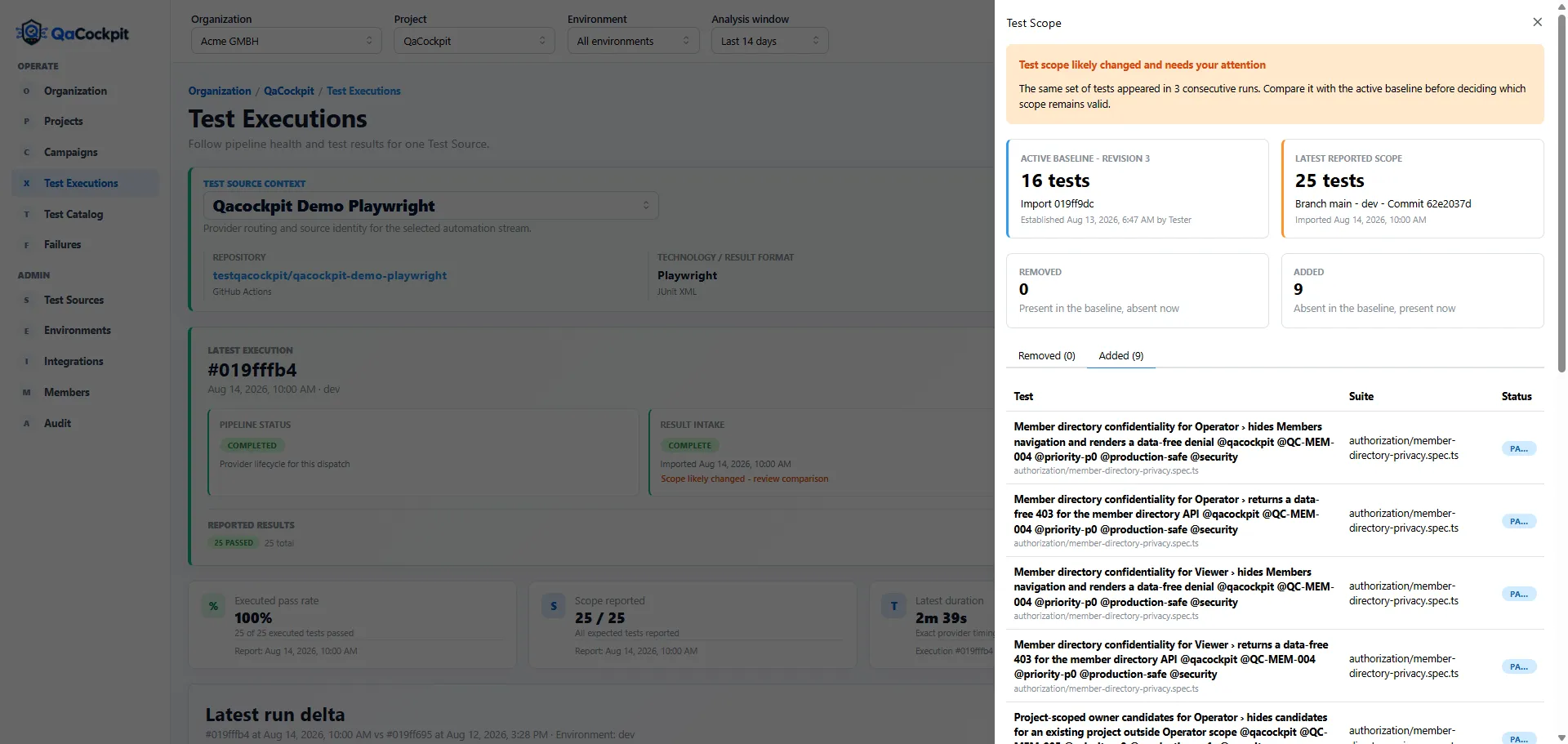
A green CI/CD workflow feels definitive. The jobs completed and the checks passed, so the release must be safe. But the color of a pipeline describes what the pipeline observed. It does not prove that the intended regression scope actually ran and reported usable evidence.
That distinction becomes more important as automation grows across repositories, frameworks, owners, and environments.
Passing observed tests is not the same as completing scope
Imagine a workflow expected to report 800 tests. A configuration mistake excludes one suite, and the remaining 620 tests pass. The CI/CD job may be green. Every observed test passed, but the regression signal is incomplete.
A useful TestOps view therefore needs at least two sets of information:
- Expected scope: what the source or campaign intended to collect.
- Observed results: what the test framework actually reported.
The difference between them is not reporting noise. Results missing is an operational
condition worth investigating in its own right.
This is also why a successful workflow should not silently become a successful test outcome. Pipeline lifecycle, result intake, and test outcome describe different things.
Context turns a count into evidence
Counts alone do not explain whether a result can support a decision. Every execution should retain the context that makes it reproducible and reviewable:
- Test Source and run configuration;
- repository, branch, and commit;
- target environment;
- provider run identifier and attempt;
- timestamps and duration;
- imported result files;
- logs and protected artifacts when available.
When a rerun happens, it should create a new attempt rather than overwrite the first one. An initial failure followed by a pass tells a different story from a single green result. The first attempt may reveal an unstable test, an environment issue, or repeated setup cost that deserves attention.
Check whether your own process makes these gaps visible: try the Release Visibility Check. Get a score and practical next steps based on your answers, with no email required.
A missing report is itself a bottleneck
Teams often focus on slow test execution while ignoring the time between execution and a usable result. A pipeline can finish quickly and still leave the organization waiting for a report, a manually assembled summary, or an artifact that only one person knows how to find.
That waiting time belongs in the quality process. It affects how quickly the team can diagnose, communicate, and decide.
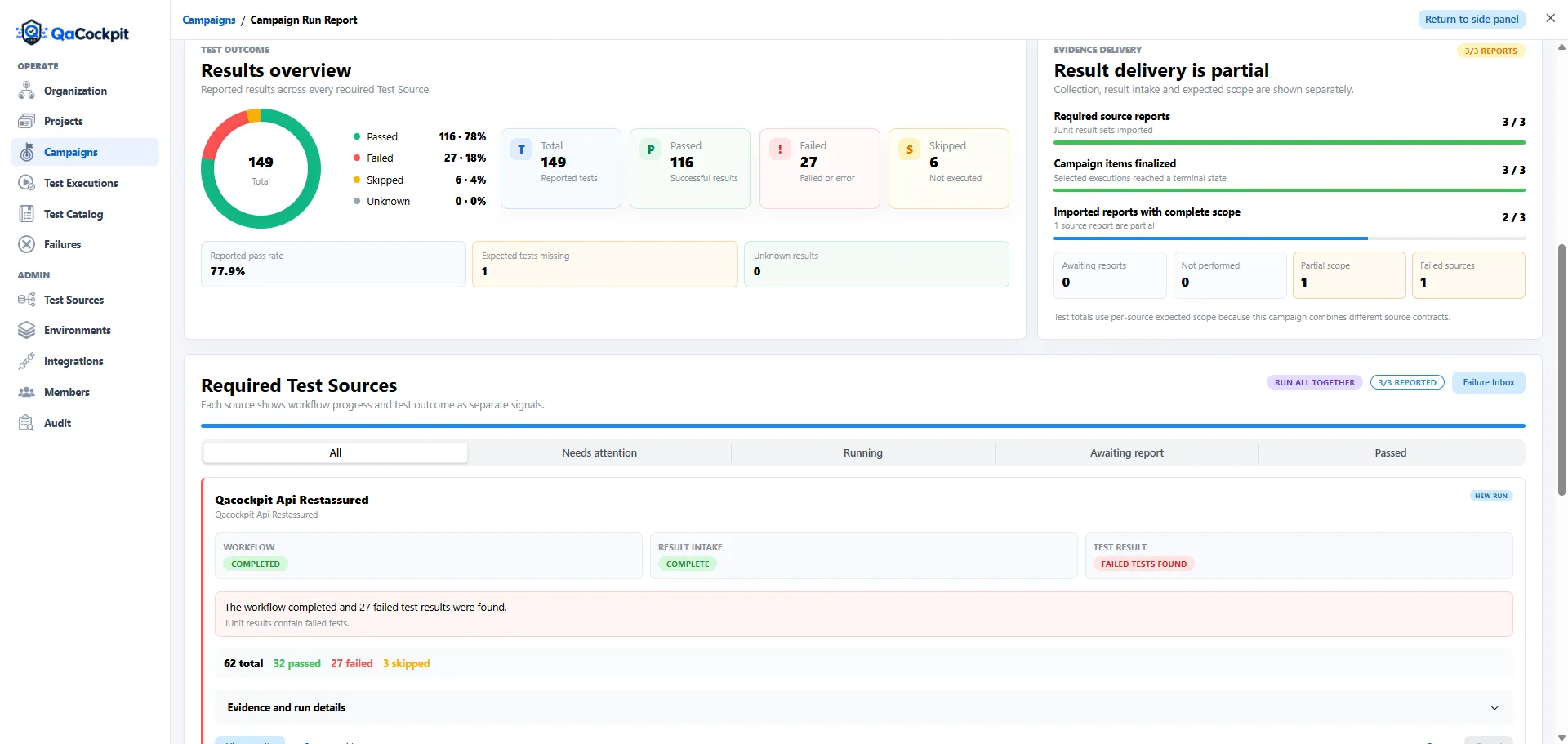
A finished collection and a complete Test Scope are separate signals. The report keeps both visible instead of turning them into one ambiguous status.
Useful questions include:
- How often does a completed run fail to deliver its expected report?
- Which Test Sources produce stale or incomplete evidence?
- How long does it take to move from a failed run to an owned investigation?
- How many reruns are needed before the team trusts the signal?
Preserve technical detail without overwhelming stakeholders
Result importers may retain technical states such as passed, failed, skipped, error, and
unknown. A product-facing summary can group failed and errored cases into one clear
Failed outcome while still preserving the raw distinction for diagnosis.
The same principle applies to reports. Stakeholders need a clear management summary; engineers need the exact failure message, stack, stdout or stderr, and artifacts. Both views should point to the same underlying execution record rather than separate versions of the truth.
Build confidence from complete evidence
The objective is not to make dashboards look green. It is to give a team enough reliable evidence to decide what to do next.
That requires comparing expectation with observation, preserving execution context, and making incomplete evidence explicit. A trustworthy quality signal may sometimes be less comfortable than a green pipeline—but it is far more useful.
The implementation starts with a retained JUnit XML evidence contract and an explicit Test Scope baseline. Provider-specific examples are available for GitHub Actions and Azure DevOps.
QaCockpit Cloud treats completeness as a first-class product concept. If missing results or manual evidence collection spans Azure DevOps pipelines, explore QaCockpit for Azure DevOps or tell us how your current landscape works.