
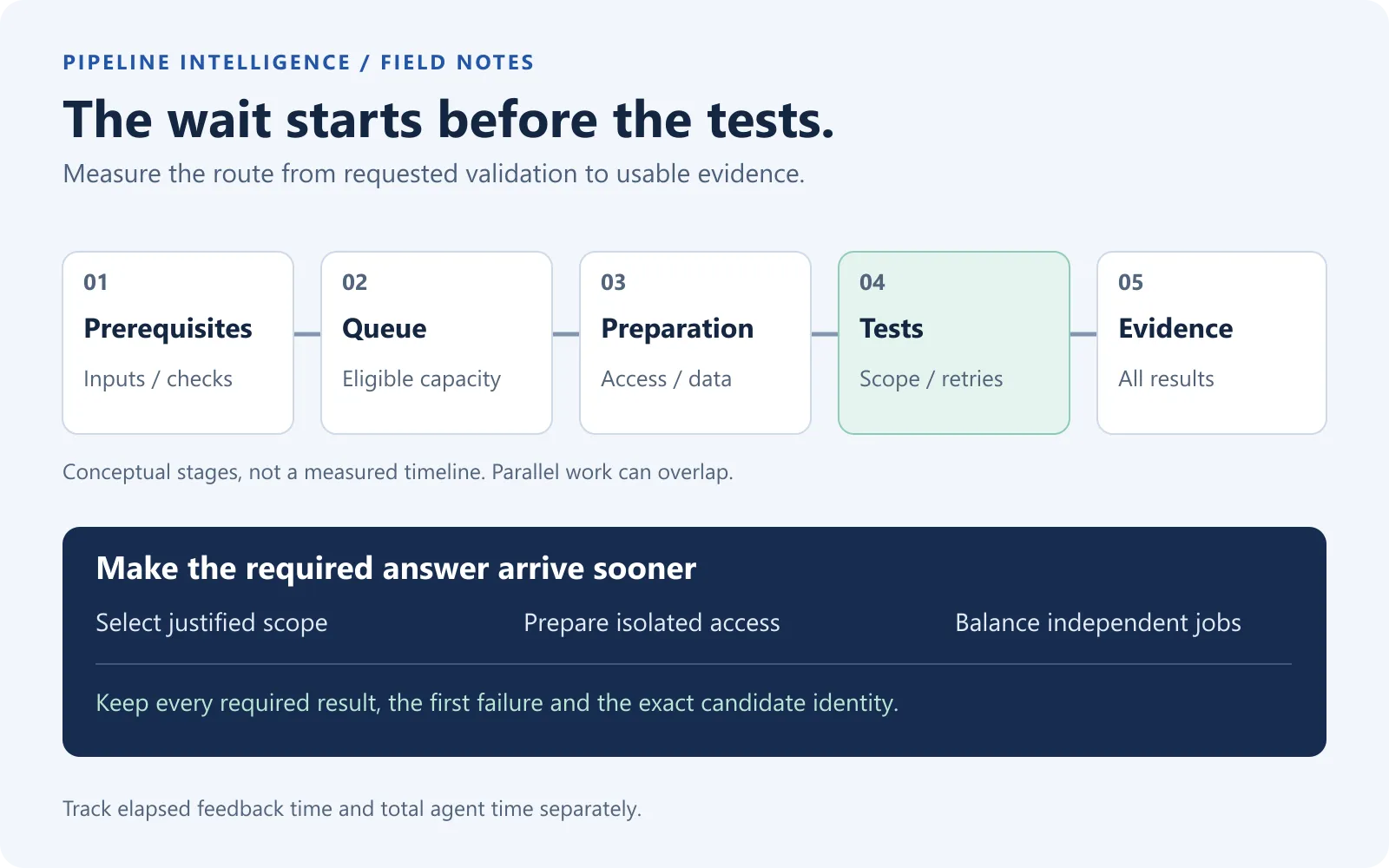
In a project QaCockpit’s product owner worked on, getting UI tests to the environment required a precise sequence of DevOps templates. Different identities retrieved different access material. Credentials and other outputs passed through several steps and pipelines. The sequence had to be followed exactly before a browser test could reach its target.
The striking part was the mismatch: the machinery for managing access and delivery had become much more complicated than the application appeared to require.
This is an anonymized practitioner account. It does not establish that any individual control was unnecessary, and it comes with no measured before-and-after saving. It does give us a useful starting question: how much of the wait for test feedback is actually spent testing the product?
For engineers, that question changes what to instrument. For managers, it changes the improvement to fund. Making assertions faster has limited value when the largest delay happens before those assertions can start.
Measure the route to a usable answer
Choose a clear starting event, such as a requested validation of a specific release candidate. Record when the required result becomes available. Between those events, separate the major waits:
| Interval | What to inspect |
|---|---|
| Before the job is eligible | Dependencies, approvals, environment locks or missing inputs |
| Waiting for execution capacity | Eligible agents, pool contention and parallel-job availability |
| Preparing the job | Checkout, tools, packages, artifact downloads and browser installation |
| Preparing access and state | Service connections, secret retrieval, application login, test data and readiness checks |
| Running tests | Actual test bodies, fixtures, hooks, retries and slow external calls |
| Producing the result | Reports, traces, screenshots, uploads and completeness checks |
Some intervals overlap and some setup occurs inside the test runner. Measure their boundaries instead of adding labels that count the same time twice. For parallel work, follow the longest dependency path to the required answer; adding every job duration measures something different.
Keep first-attempt duration, retry time and final outcome separately. A fast eventual pass can conceal a slow, unreliable route to that pass.
Draw the access path before adding another template
For a setup like the opening account, map each handoff: which identity requests which resource, which template performs the operation, what the next step consumes, and which permission or isolation boundary it protects.
That review may justify several identities. A deployment identity should not automatically become an application test user, and tests for different roles need to exercise the intended permissions. The aim is to remove accidental duplication, not replace every identity with one broadly privileged account.
For each handoff, ask:
- Is this a required trust boundary or a historical convention?
- Does the consumer need a secret, a short-lived identity, an artifact reference, or only a readiness signal?
- Is the same expensive setup repeated for every test or shard?
- Can the operation fail early with a specific diagnosis?
- Who owns the template and tests changes to its contract?
Azure supports templates that enforce security controls. A shared template can make the approved route consistent. A chain of undocumented wrappers can make that route difficult to understand. Give shared setup named inputs, explicit outputs, timing and an owner so consumers can diagnose it without copying it.
For supported Azure resource access, assess a service connection using workload identity federation. It can remove the need to maintain a long-lived connection secret. It does not automatically solve application login, network access, test-user authorization or every third-party credential. Keep authorization narrow and explicit per pipeline.
Do not replace awkward handoffs by placing credentials in ordinary artifacts, caches or logs. Simplification is useful only if the resulting access model still matches the environment’s risk.
Check preconditions once at the right boundary
An environment can respond to HTTP while still being unsuitable for a test. It might contain the wrong application version, be missing a dependency, reject the intended role, or have incomplete test data.
A bounded preflight can check the candidate version, required endpoints, the intended test identity and the minimum fixture before launching expensive scenarios. Report a failed precondition as a setup problem, with a useful cause. Do not turn it into a green run in which all tests silently disappeared.
“Once” means once for an appropriate lifetime and isolation boundary. A shared check can become stale; a worker with different credentials may need its own validation. Prefer a readiness condition with a deadline over an arbitrary long sleep.
Browser authentication is another boundary worth making explicit. Playwright supports reusing authenticated state, but its guidance distinguishes tests that can safely share an account from tests that change server-side state and need independent accounts. It also warns that stored authentication state can impersonate the account. See Playwright authentication.
Reuse appropriate state within the test execution, protect it and refresh it when needed. Keep dedicated tests for the real login and authorization flows. Reusing a session for unrelated scenarios must not erase the behavior those dedicated tests are meant to verify.
Choose a gate by the risk it covers
“Run the full suite” is easy to specify. It can also postpone every decision until the most expensive check completes. A useful alternative is an explicit test-selection contract, not an unexplained smaller number of tests.
| Decision point | Candidate scope | Required explanation |
|---|---|---|
| Before merge | Focused unit, component, contract and selected integration checks | Which changed behavior and shared dependencies are covered? |
| Before deployment | Candidate-specific checks and essential release risks | Is the evidence for the exact artifact and relevant configuration? |
| After deployment to the target | Small smoke checks against the deployed version | Which critical journeys and environment assumptions are verified? |
| Scheduled or change-triggered deeper validation | Broader compatibility, long-running and less frequent scenarios | What detection delay is acceptable, and what forces an earlier run? |
This is a design starting point, not a universal release policy. A payment, access-control or migration change may require wider evidence than a cosmetic change. A path filter alone can miss shared-library, configuration or infrastructure effects.
For every reduced gate, record included scope, omitted scope, selection reason and the condition that triggers a broader run. A result collected earlier is reusable only while its candidate, dependencies, configuration and freshness remain relevant.
Managers should be able to see the tradeoff: what feedback becomes faster, which risk is still covered, and which uncertainty is deliberately deferred. Test count is a poor substitute for that explanation.
Give flaky tests a repair path, not a hiding place
A rerun can help distinguish a transient failure from a repeatable one. It does not prove that the application is correct. Playwright, for example, distinguishes tests that pass first time, pass on retry, and continue to fail; preserve those distinctions in the evidence. See its retry behavior.
Before quarantining a test, investigate whether instability belongs to the test, application, environment, shared account or data. A product race condition is not made safe by relabeling its detector as flaky.
When quarantine is justified, make it a controlled decision:
- identify the test and the risk that it covers
- assign an owner, a repair deadline and a re-entry criterion
- keep running it in an observable scope with a bounded retry policy
- provide an alternative check or explicit risk acceptance when it leaves a blocking gate
- report quarantined failures and excluded scope beside the release result
A tag, test project or separate pipeline is often enough. Moving tests into another repository adds versioning and ownership boundaries; use that only when those boundaries solve a real problem. A separate pipeline using the same saturated pool can still delay the release.
Native Azure flaky-test management can help record and surface flaky status. It does not decide which product risks the team may exclude from a release gate.
Parallelize the work that can remain independent
Splitting a suite into four shards creates four jobs. It does not promise a result four times sooner. The outcome depends on eligible capacity, the slowest shard, repeated setup and whether the target environment tolerates the extra concurrency.
Playwright supports sharding across jobs and merging their reports. Design around the actual execution units and their measured duration. Equal test counts do not imply equal execution time.
Check the whole result:
- isolate mutable accounts and test data between workers
- compare setup time with useful test execution in each shard
- keep the target service and identity provider within acceptable load
- ensure every required shard reported, even after failures
- retain the initial failure, retry history and exact candidate identity
Four passing reports out of five required shards are incomplete evidence. A report merge must not make the missing shard disappear.
Also compare elapsed feedback time with total agent time. Parallelization can improve the former while increasing the latter. The relevant management choice is whether that tradeoff buys timely, trustworthy evidence without taking capacity from more urgent work.
Run one improvement experiment
Return to the complicated access setup. A credible first experiment might consolidate duplicate setup inside one documented job boundary, validate preconditions early, and reuse an appropriate authenticated session for tests that do not exercise login.
That is a proposal, not a claim about what happened in the original project. Start by measuring it on comparable runs, with the same candidate class, required scope and environment constraints.
Record time to first useful failure, time to complete evidence, preparation time, retry time, total agent time and missing-result incidents. Keep the old path available until the new one has demonstrated the required behavior. Faster feedback accompanied by lost coverage or weaker access isolation is not the intended result.
For the wider resource and dependency picture, use the companion guide to pipeline health across projects. The next focused investigations are access-template design, preflight contracts, test selection, flaky-test repair and shard balancing. Each deserves its own measured example.
QaCockpit for Azure DevOps helps organize the available test evidence. Its Pipeline Intelligence module is a private pilot as of preparation on 6 October 2026, not a promised capability of the current public installation. Neither an overview nor a duration chart chooses the right test gate on the team’s behalf.
The practical objective is specific: make the required answer arrive sooner, while keeping its scope, reliability and connection to the release candidate visible.