
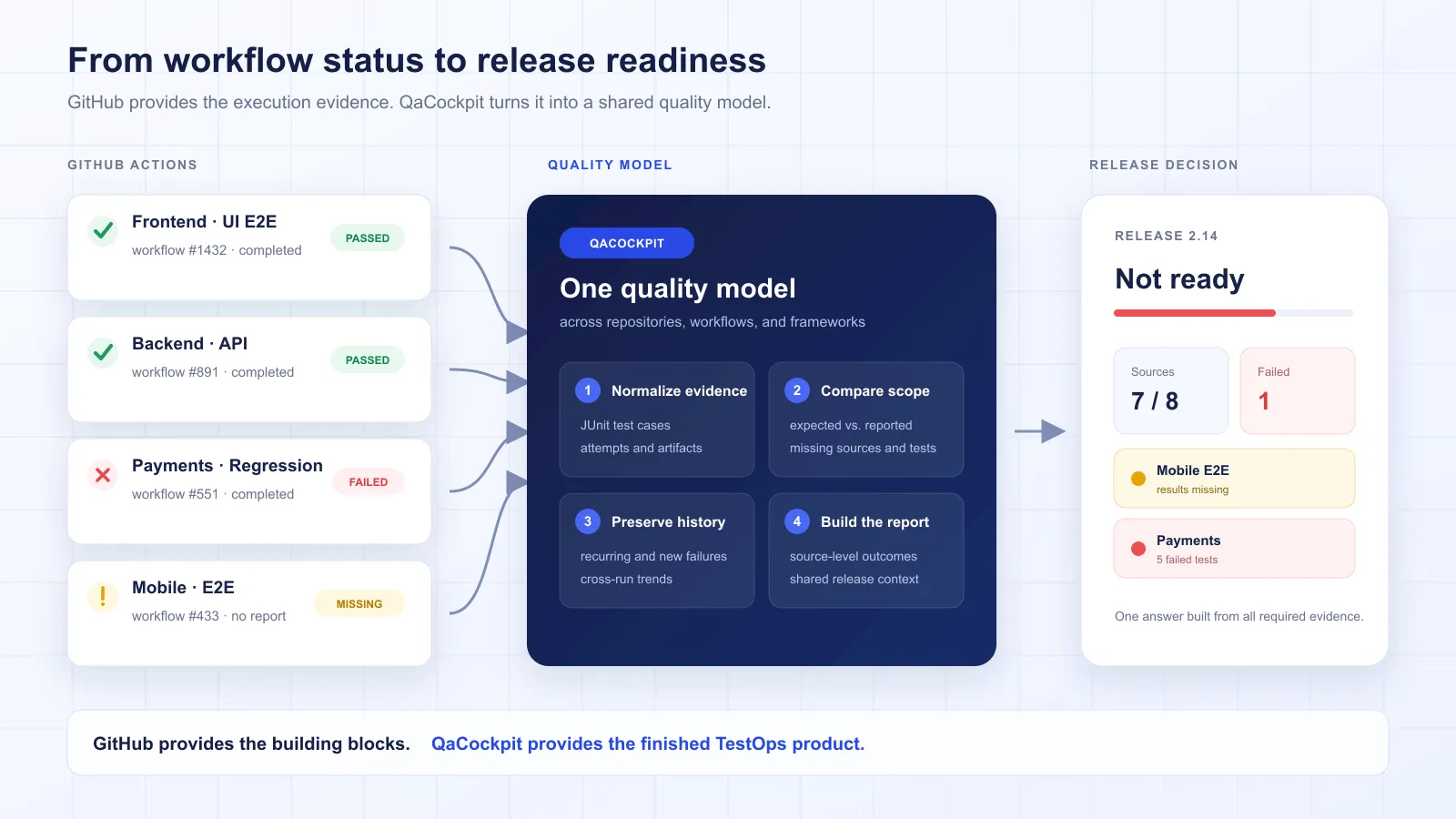
Yes—GitHub can support a convincing release board.
GitHub Projects offers table, board, and roadmap views, custom fields, filters, grouping, automation, and charts. GitHub Actions adds workflow and job status, logs, artifacts, annotations, and Markdown job summaries. The Checks API lets a GitHub App publish rich summaries, line annotations, images, and actions.
So the honest answer is not, “GitHub cannot do this.” A capable engineering team can combine Actions, Projects, APIs, scripts, and a custom dashboard to create a view of release quality.
The more useful question is: what will the team have to build and maintain before that board becomes a dependable quality system?
A board of work is not yet a model of test evidence
The native items in a GitHub Project are issues, pull requests, and draft issues. That is an excellent model for planning and tracking work. It can represent a release checklist such as:
- Frontend regression;
- Backend regression;
- Payments E2E;
- Identity integration;
- Mobile E2E.
But each card is still a work item. Something must create it, connect it to the correct workflow, update its fields, decide what counts as complete, and keep it synchronized when a workflow is rerun or a report never arrives.
A test operation has a different set of primary objects:
- Test Sources and their expected result scope;
- individual Test Executions and immutable attempts;
- normalized test cases imported from JUnit reports;
- reusable regression or release campaigns;
- missing source reports, tests, and artifacts;
- failure history across executions and repositories.
You can encode parts of that model into issues and custom fields. But then your team owns the translation layer.
GitHub shows executions well
For a product spread across several repositories, GitHub may show a clear collection of workflow outcomes:
| Repository or scope | Workflow run | Status |
|---|---|---|
| Frontend UI E2E | actions/1432 |
Passed |
| Backend API | actions/891 |
Passed |
| Payments regression | actions/551 |
Failed |
| Identity integration | actions/433 |
Passed |
That is valuable execution evidence. The job summary can expose test totals without requiring someone to open the logs, and workflow artifacts can retain reports, screenshots, traces, and other outputs.
The business question is usually one level higher:
Is Release 2.14 ready—and is the evidence complete enough to trust the answer?
Answering that question requires an explicit expected scope. If the release requires eight Test Sources, seven workflows completed, six reported passing tests, one reported failures, and one delivered no result, the conclusion is not simply the color of the last workflow.
It is a release-level state built from several independent signals.
The custom system hiding behind a “simple board”
To generate that state automatically in GitHub, a team needs to implement decisions and automation for at least the following:
- Define which repositories, workflows, branches, and test scopes belong to each release or regression campaign.
- Correlate workflow runs and reruns with the correct release, environment, commit, and attempt.
- Collect JUnit reports from different frameworks and normalize their slightly different XML dialects.
- Compare expected sources and expected tests with the evidence that actually arrived.
- Distinguish a failed workflow, failed tests, a missing report, and a partial report.
- Preserve artifacts and connect them to the exact execution, test, and failure.
- Build history across runs so recurring failures, new failures, and trends remain visible.
- Keep the Projects automation, GitHub App, API integration, storage, permissions, and dashboard working as GitHub and the test estate change.
None of this is impossible. It is simply a product that someone inside the company must own.
Where QaCockpit Cloud begins
QaCockpit Cloud does not replace GitHub Actions. Repositories still own the test code and workflow definitions. GitHub still owns runners, jobs, secrets, and execution.
QaCockpit Cloud adds the quality layer above those runs:
- a project-level inventory of Test Sources;
- reusable campaign scope across multiple repositories;
- expected-versus-reported evidence;
- JUnit test-case normalization;
- explicit
Results missingstates; - attempt and rerun history;
- failure clustering and investigation context;
- protected artifact evidence;
- one campaign or release report shared by engineering, QA, and stakeholders.
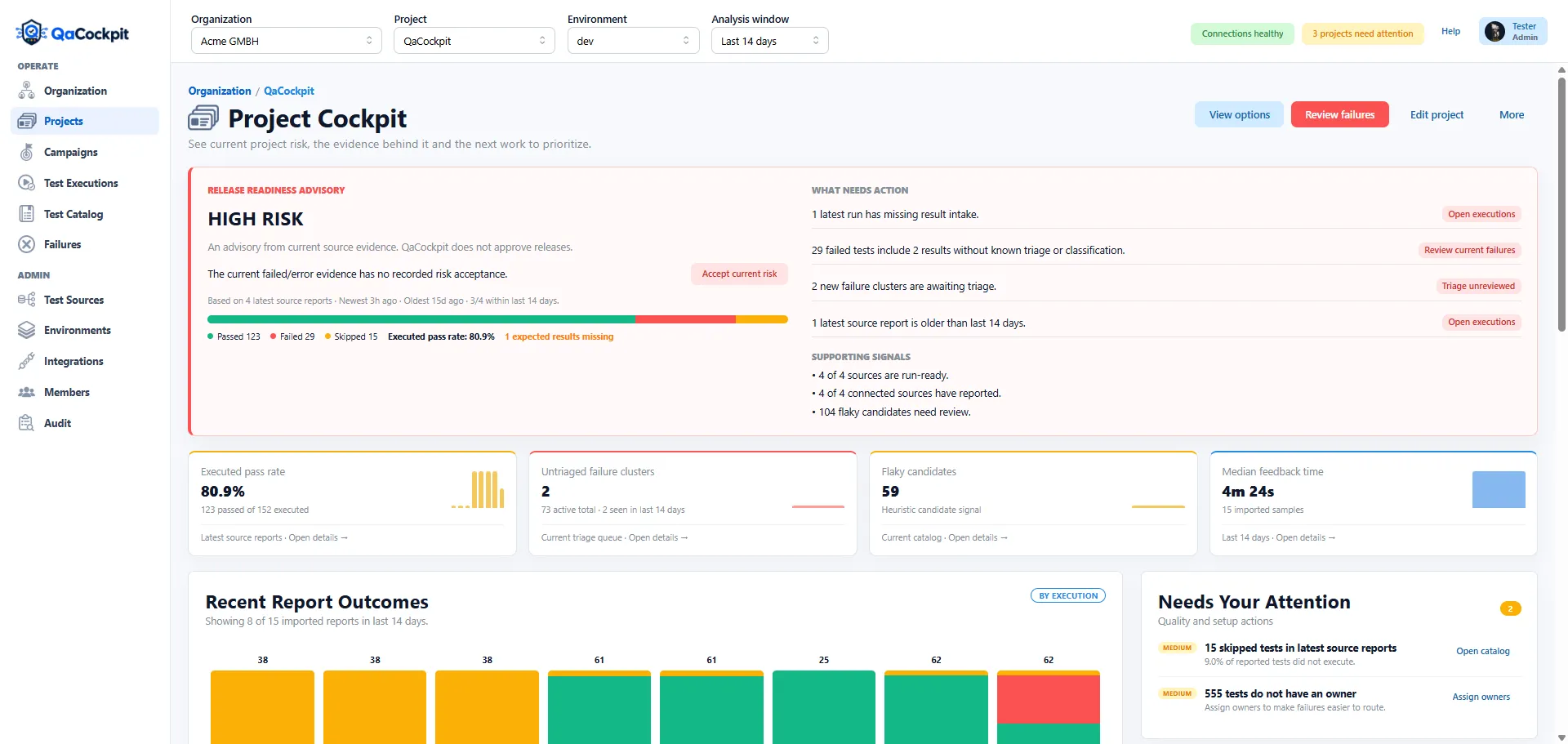
A real release-readiness view combines current evidence, missing intake, failure state, and the work that needs attention. It is not a manually maintained Kanban status.
The positioning is deliberately straightforward:
You can build this in GitHub. QaCockpit Cloud means you do not have to.
GitHub provides the building blocks. QaCockpit Cloud provides the finished TestOps product that turns those building blocks into a consistent quality model.
Which manual tasks should disappear?
The value is not another dashboard tab. It is removing the recurring coordination work needed to make distributed automation understandable:
- opening workflow runs across several repositories to assemble one status;
- downloading reports and artifacts to check whether evidence is complete;
- copying test counts and failure lists into an issue, document, or chat message;
- manually updating release-board cards after reruns;
- noticing that a required suite or source never reported;
- deciding whether two failures are repeats of the same problem;
- rebuilding historical comparisons from retained provider runs;
- maintaining the internal scripts and API glue that automate those steps.
The outcome should be a report generated from the actual executions—not a second system that asks people to restate what happened.
When GitHub alone is enough
If a team has one repository, one workflow, one test suite, and a small group of people who already understand its output, GitHub may be all it needs. A good job summary and well-retained artifacts can provide a clear and economical solution.
A dedicated TestOps layer becomes more useful when the release spans many repositories, workflows, frameworks, environments, or product teams—and when someone is repeatedly reconstructing the same quality story by hand.
A practical signal is not simply “the company uses GitHub.” It is closer to:
- GitHub Actions is the primary execution platform;
- the product is multi-repository or service-oriented;
- regression scope crosses team or repository boundaries;
- QA is small, or quality is owned jointly by developers and QA;
- releases happen often enough that manual coordination is recurring work.
Complement the execution platform
GitHub Projects manages work. GitHub Actions executes automation. QaCockpit Cloud interprets the resulting test evidence across the scope that matters to the product.
For an implementation-level example, follow the GitHub Actions JUnit artifact guide or inspect the public Playwright and REST Assured workflows.
Those responsibilities can coexist cleanly. The objective is not to move test execution away from GitHub. It is to stop rebuilding release-level quality context every time a decision is needed.
If your current release status is assembled from several Actions workflows, request a quality-landscape review. We will map the manual steps, existing evidence, and the smallest useful campaign model without asking you to replace your CI/CD.