
Modern test automation rarely lives in one tidy place. A product may have browser tests in Playwright, service checks in another language, database validation in a separate repository, and CI/CD workflows owned by different teams.
That distribution is often healthy. Each suite can use the tools, dependencies, and release cadence that fit it best. The problem appears one level above execution: the organization has more test output, but not necessarily more shared understanding.
The gap between execution and understanding
CI/CD providers are excellent at executing jobs. A pipeline page can show that a workflow finished, which job failed, and where its logs live. It usually cannot answer the broader quality questions across a product:
- Which sources were required for this regression?
- Did every expected test report a result?
- Is this failure new, repeated, or already being investigated?
- Where is the evidence for the exact commit and environment?
- Which source, suite, or test is slowing feedback over time?
- Are teams improving the quality of their automation or only adding more tests?
When this context is spread across pipeline pages, attachments, spreadsheets, and chat, the real cost is not only reporting effort. Engineers repeat investigations, release decisions depend on incomplete evidence, and quality bottlenecks remain local knowledge.
Keep execution where it belongs
QaCockpit Cloud is designed as a control plane above existing CI/CD. It does not become a general-purpose environment for executing customer code. Repositories remain the source of truth for test code and workflow definitions. GitHub Actions or Azure DevOps keeps the execution environment, dependencies, runners, and secrets.
QaCockpit Cloud connects the operational concepts around those runs:
- Projects and Test Sources describe the business product and its technical automation streams.
- Test Executions and attempts preserve the exact provider and run context.
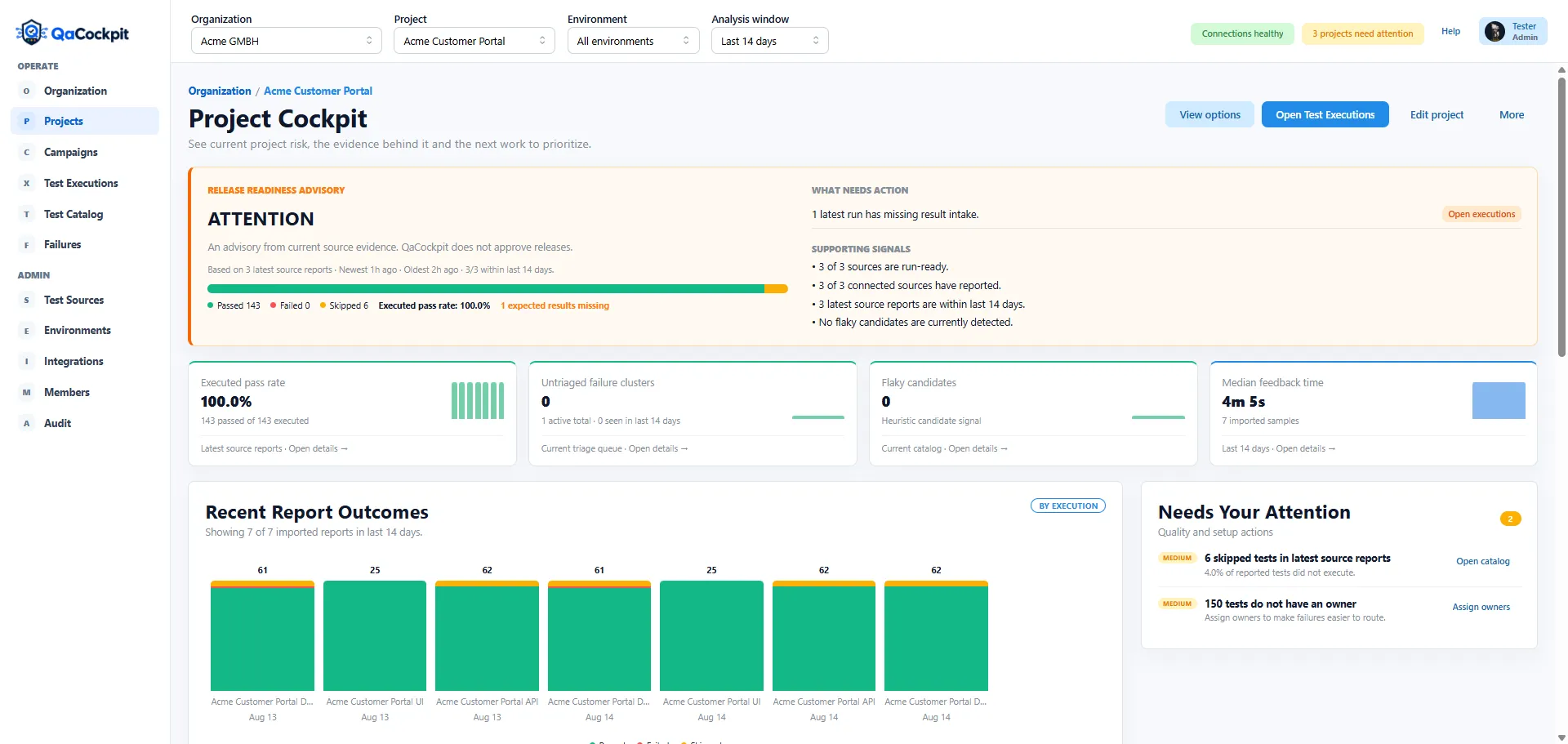
- Campaigns collect evidence from several sources into one regression or release report.
- Results and expected scope show both what reported and what is missing.
- Test Catalog and Failure Inbox turn isolated outputs into persistent quality work.
The result is one product-level view without forcing every team into the same repository, framework, or pipeline convention.
Quality intelligence should lead to action
A dashboard is useful only when it changes what a team can do next. QaCockpit Cloud is built to shorten the distance between a signal and the evidence behind it:
- a stakeholder can understand the state of a product without opening every pipeline;
- a QA lead can see weak coverage, missing reports, source health, and ownership gaps;
- an engineer can move from a failure cluster to the exact occurrence, stack, environment, attempt, and protected artifact;
- a team can use history to prioritize recurring failures, slow feedback, and automation maintenance.
This is where test automation becomes more than execution capacity. It becomes a source of organizational understanding that supports faster diagnosis, clearer release evidence, and continuous improvement.
A quality advantage is built over time
Better quality insight does not guarantee a perfect release. It makes avoidable blind spots harder to ignore and helps teams invest their effort where evidence shows the greatest need. Over time, that supports more predictable delivery and stronger customer trust.
QaCockpit Cloud is in early access, and the roadmap is being validated with real automation landscapes. We are looking for reusable problems across quality organizations—not an unbounded list of custom features.
If your teams run tests across several repositories or CI/CD workflows, request a quality-landscape review and tell us where context is lost today.