
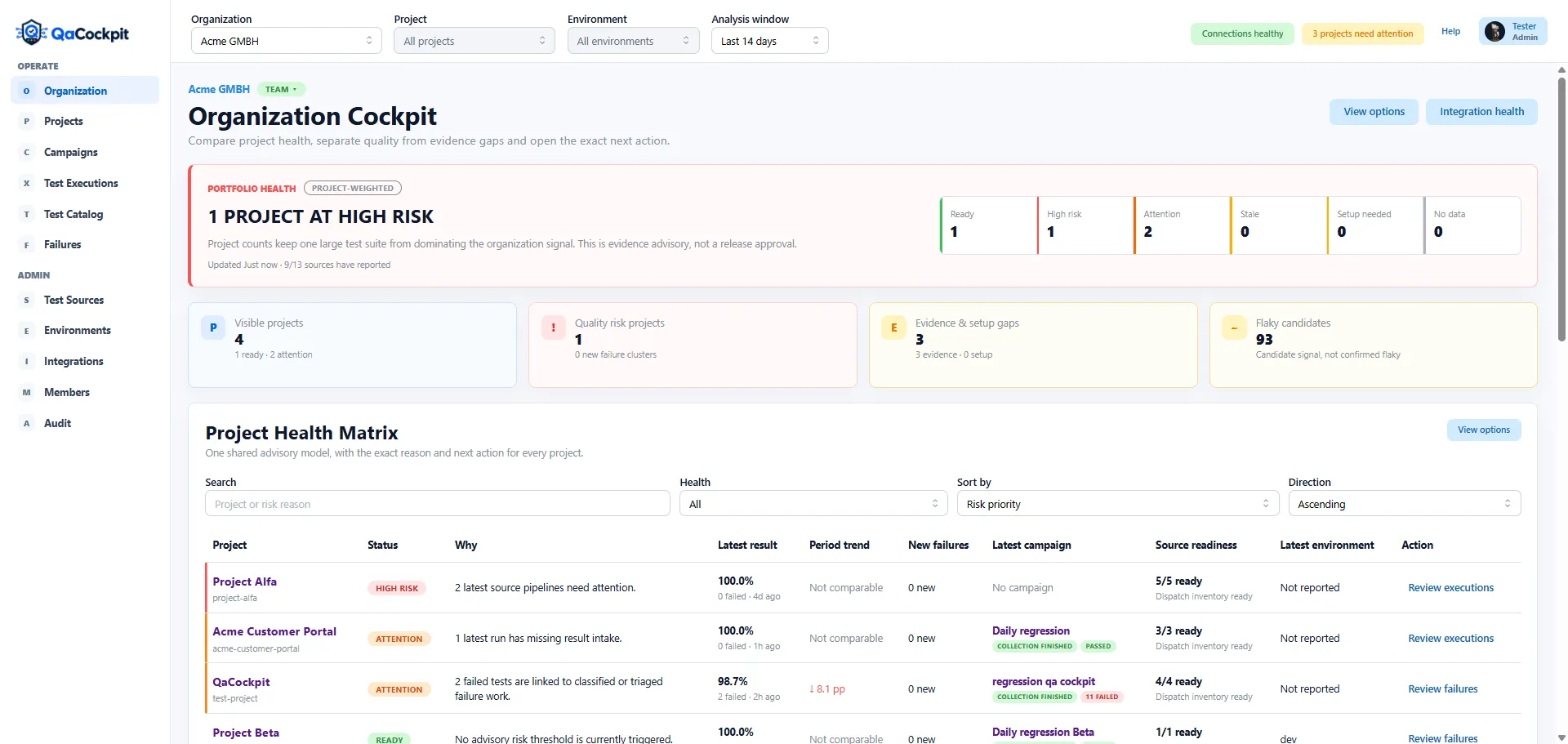
Quality is often discussed as a gate near the end of delivery: run regression, count the failures, and decide whether the build can move forward. That framing is too narrow.
Quality affects how quickly a company can learn, how confidently it can change its product, how much engineering time is spent repeating investigations, and how often customers encounter problems the organization could have seen earlier.
The advantage does not come from having the largest number of automated tests. It comes from understanding what those tests say and acting on that understanding consistently.
More tests can still produce weak decisions
Automation increases execution capacity. It does not automatically create organizational clarity.
A company may run thousands of tests every day while still struggling to answer:
- Which test sources are healthy enough to trust?
- Did the intended regression scope actually report?
- Which failures are repeated versions of the same issue?
- Which suites slow feedback the most?
- Where does ownership disappear between teams?
- Which parts of the product have stale or weak evidence?
If answering those questions requires several pipeline pages, spreadsheets, and private knowledge, the automation estate is producing output without enough perspective.
Quality understanding changes the economics of engineering work
Every unclear failure creates follow-up work. Someone finds the correct run, checks the environment and commit, downloads an artifact, asks whether the issue happened before, and identifies who can investigate it.
When the same reconstruction happens repeatedly, diagnosis becomes an invisible tax on delivery. The team pays in interrupted engineering time, slower feedback, and delayed decisions.
A shared quality view cannot remove every failure. It can reduce the effort required to understand the failure and avoid losing its history. That changes how quickly the organization can respond and how much time remains for preventive improvement.
Better evidence supports more predictable releases
A release decision should distinguish at least three questions:
- Did the required pipelines execute?
- Did the expected test results arrive?
- What did those tests report?
A green provider workflow answers only part of that chain. A missing suite, incomplete report, or absent artifact can weaken the evidence even when the observed tests passed.
Making completeness visible does not make delivery slower. It makes uncertainty explicit before it reaches customers.
Historical context turns reaction into improvement
The first occurrence of a failure is an incident. The fifth similar occurrence is a pattern. A test that slows one run is inconvenient. A suite whose duration grows every month may be a delivery bottleneck.
History helps a team move from asking What broke today? to asking:
- What repeatedly consumes investigation time?
- Which sources produce the least dependable evidence?
- Where is test maintenance debt increasing?
- Which product areas lack current quality signals?
- Is automation growth improving confidence or only increasing duration?
This is the beginning of quality intelligence: connected evidence that helps prioritize the next improvement.
Customer trust is an operational outcome
Customers do not see test counts or pipeline dashboards. They experience stability, predictability, and how quickly problems are resolved.
Better quality understanding cannot guarantee perfect software. It helps teams prevent avoidable blind spots, diagnose customer-impacting problems with more context, and make improvement a continuous operating practice rather than a reaction before release.
Over time, those capabilities support stronger product quality and customer trust. That is where quality can become a competitive advantage.
Start with one shared question
An organization does not need an advanced scoring model on day one. It needs a reliable place to answer a few shared questions:
- What needs attention?
- What evidence do we have?
- What is missing?
- Has this happened before?
- Who can act next?
QaCockpit Cloud is being built around that operating loop. It connects existing CI/CD and test automation rather than replacing them, then preserves the context required to understand and improve the quality signal.
If your organization has plenty of test output but still reconstructs the quality story by hand, request a quality-landscape review.