
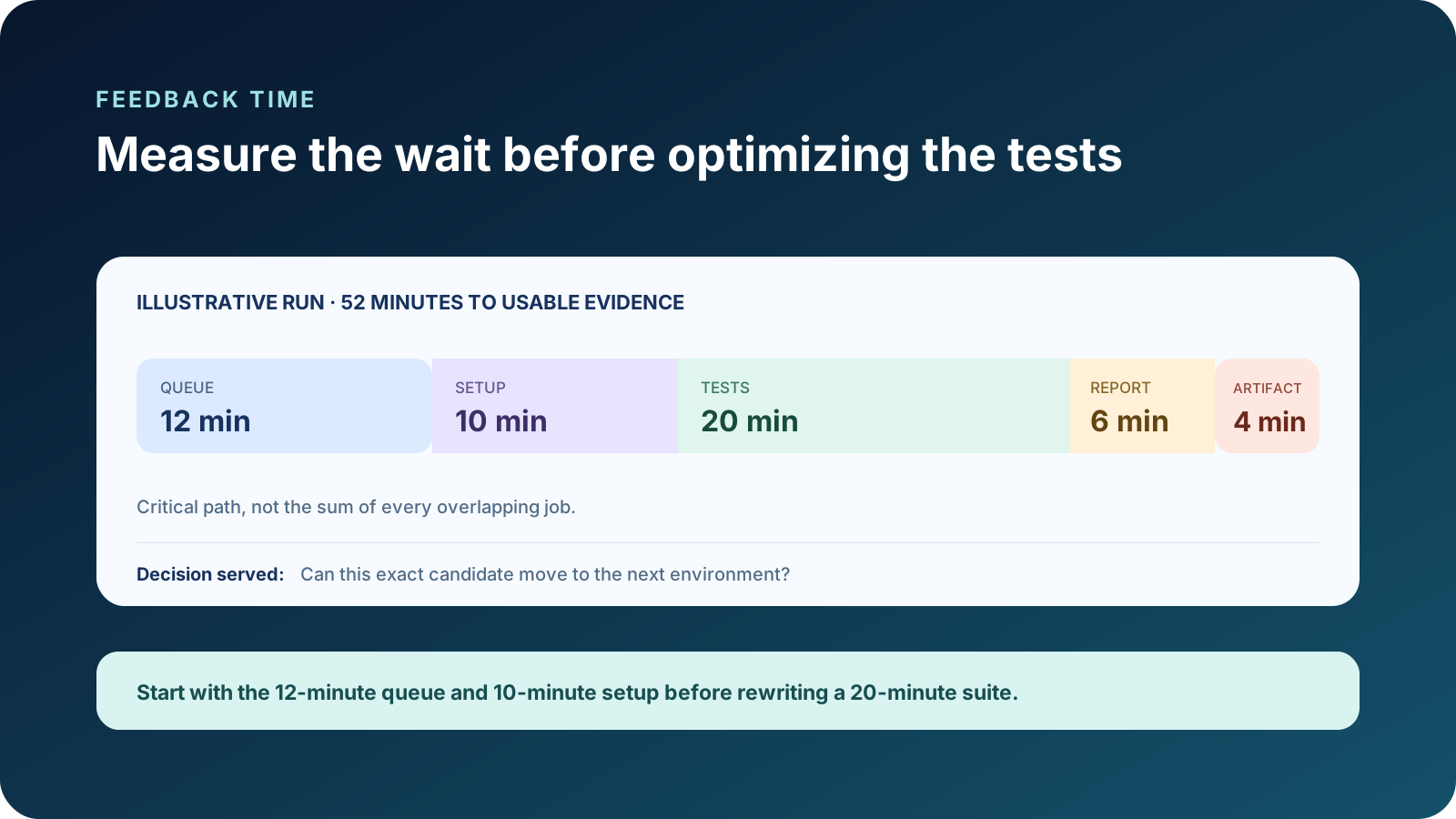
“The tests take 52 minutes” may be false even when the pipeline takes 52 minutes.
The run might spend 12 minutes waiting for capacity, 10 minutes preparing tools and data, 20 minutes executing tests, six minutes publishing results, and four minutes uploading artifacts. Rewriting test code addresses only one part of that path.
Start with the decision that is waiting, then measure the critical path to usable evidence.
Name the consumer before optimizing the producer
Ask three questions about the run:
- Who uses its result?
- Which decision does it enable?
- How fresh must that evidence be?
A nightly compatibility suite may justifiably run for hours if it covers unique risk and has an owner. A scheduled preparation pipeline may be waste if no downstream consumer uses its output. Duration alone cannot make that distinction.
Do not disable certificate checks, security scanning, provenance work, or release gates because they look slow. Identify the control and owner before changing it. The smallest improvement may be a narrower check, a different cadence, or moving work off the release critical path while preserving the deadline.
Split elapsed time into observable intervals
Use the exact Azure run timeline and record:
| Interval | Evidence to capture |
|---|---|
| Trigger to eligible job | Dependencies, checks, approvals, missing inputs |
| Eligible job to agent start | Pool, capabilities, parallel-job limit, competing work |
| Agent start to first test | Checkout, tools, packages, browser, environment, data |
| Test execution | Fixtures, hooks, bodies, retries, slow dependencies |
| Result publication | Serialization, merge, upload, completeness checks |
| Artifact processing | Trace, screenshot, package, retention work |
Some jobs overlap. Sum of task durations is not necessarily elapsed delay. Follow the longest dependency path to the decision you care about.
Azure pipeline analytics provides duration and failure views, while the pool consumption report can show queued and running work for a pool where the user has the required permissions. Microsoft documents the pool report as a separate capability with specific access requirements. See pipeline analytics and pool consumption.
Queue time is not test time
If the job is eligible but waits for an agent, inspect:
- applicable Microsoft-hosted or self-hosted capacity
- demands and agent capabilities
- organization parallel-job limits
- other projects using the same pool
- schedules that overlap the release window
- retries or shards that multiply queued jobs
An online agent does not guarantee runnable capacity for this job. Adding more shards can shorten test execution while increasing queue contention and total agent consumption.
Setup often hides inside the test label
A step called Run UI tests can install browsers, retrieve secrets, create accounts,
wait for an environment, seed data, execute tests, merge reports, and upload artifacts.
Instrument those phases separately.
Move safe, reproducible preparation earlier only when the output remains valid for the exact candidate. Cache dependencies when restore and save cost less than the work avoided. Do not cache credentials or authenticated browser sessions as ordinary build inputs.
Fail a bounded preflight with a specific setup diagnosis instead of allowing every test to fail the same login or readiness check.
Improve waits without replacing evidence with speed
Fixed sleeps are a common source of slow and unreliable UI suites. Selenium explains that a sleep can be too short under load and unnecessarily long when the page is ready quickly. Its guidance recommends synchronization mechanisms and warns against mixing implicit and explicit waits. See Selenium waits.
Playwright performs actionability checks and auto-waits for supported operations. Its locators and retrying assertions reduce manual synchronization. See Playwright auto-waiting.
Neither tool removes the need to model application readiness. A test can still wait on a real business transition, background job, or external dependency. Replace arbitrary delay with an observable condition and a useful timeout message.
Parallelize only after isolation
Independent tests can run across workers or shards. Playwright supports sharding and merged reports, but equal test counts do not guarantee equal duration. See the official sharding guide.
Before increasing parallelism:
- isolate mutable accounts and records
- remove test-order dependencies
- balance by measured duration
- verify the environment can handle the load
- require every shard’s report
- retain the exact candidate and retry history
Four successful reports out of five expected shards are incomplete evidence, not a 100% pass.
Compare performance views with the native timeline
QaCockpit Pipeline Intelligence can organize accessible pipeline activity, queue and run observations, and test-evidence signals across projects. It is available in the public Azure DevOps edition as of version 1.3.0. The view helps select a run to inspect; the native Azure timeline remains the source for exact task execution and logs.
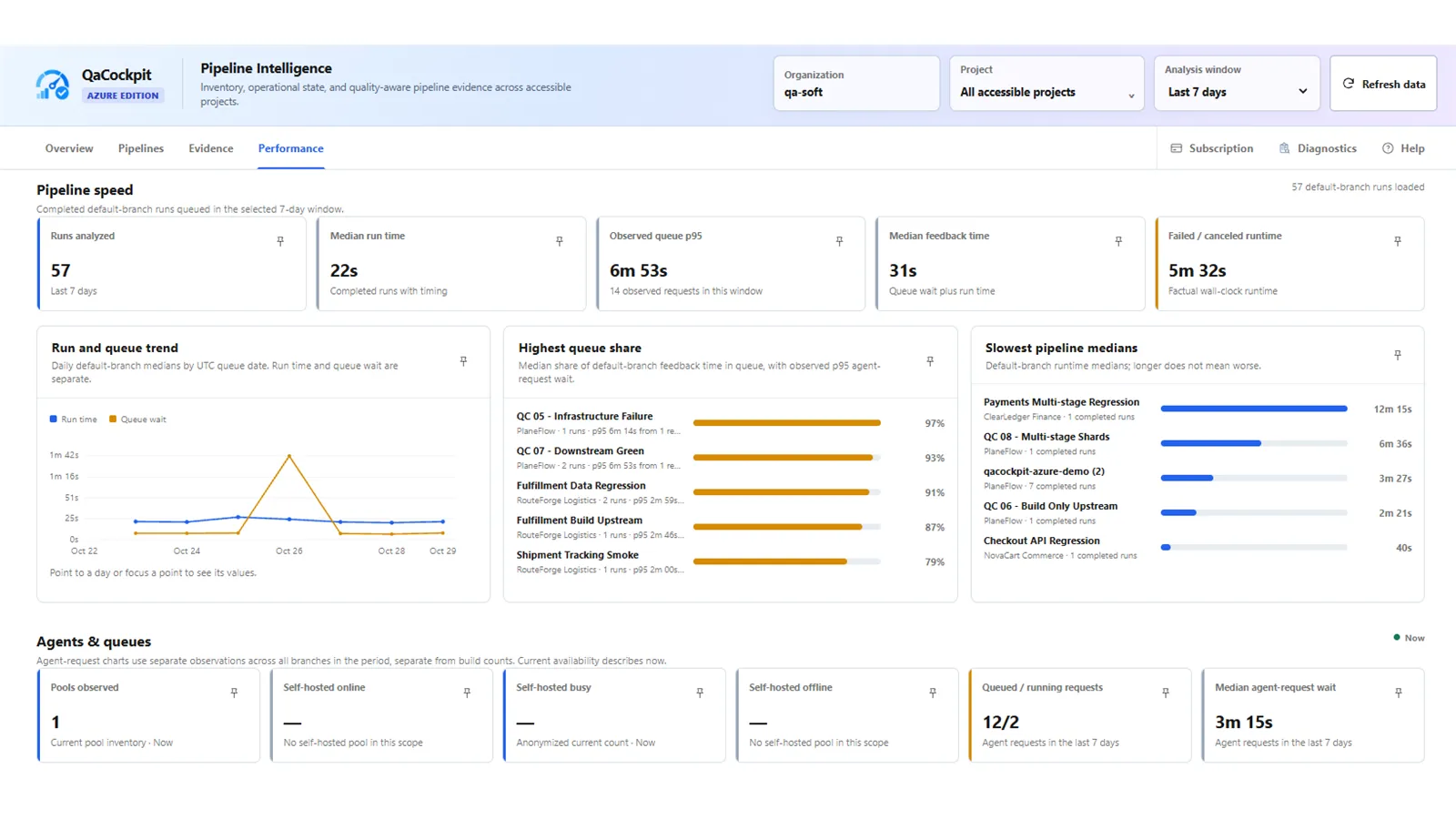
Pilot screenshot using synthetic qa-soft data, captured 29 October 2026 from
extension 0.0.121. Public capability claims in this guide remain limited to QaCockpit
for Azure DevOps 1.3.0.
Do not infer that one pipeline blocked another from overlapping timestamps alone. They must share relevant capacity or an explicit dependency. Do not describe potential time reduction as money saved without a stated cost model.
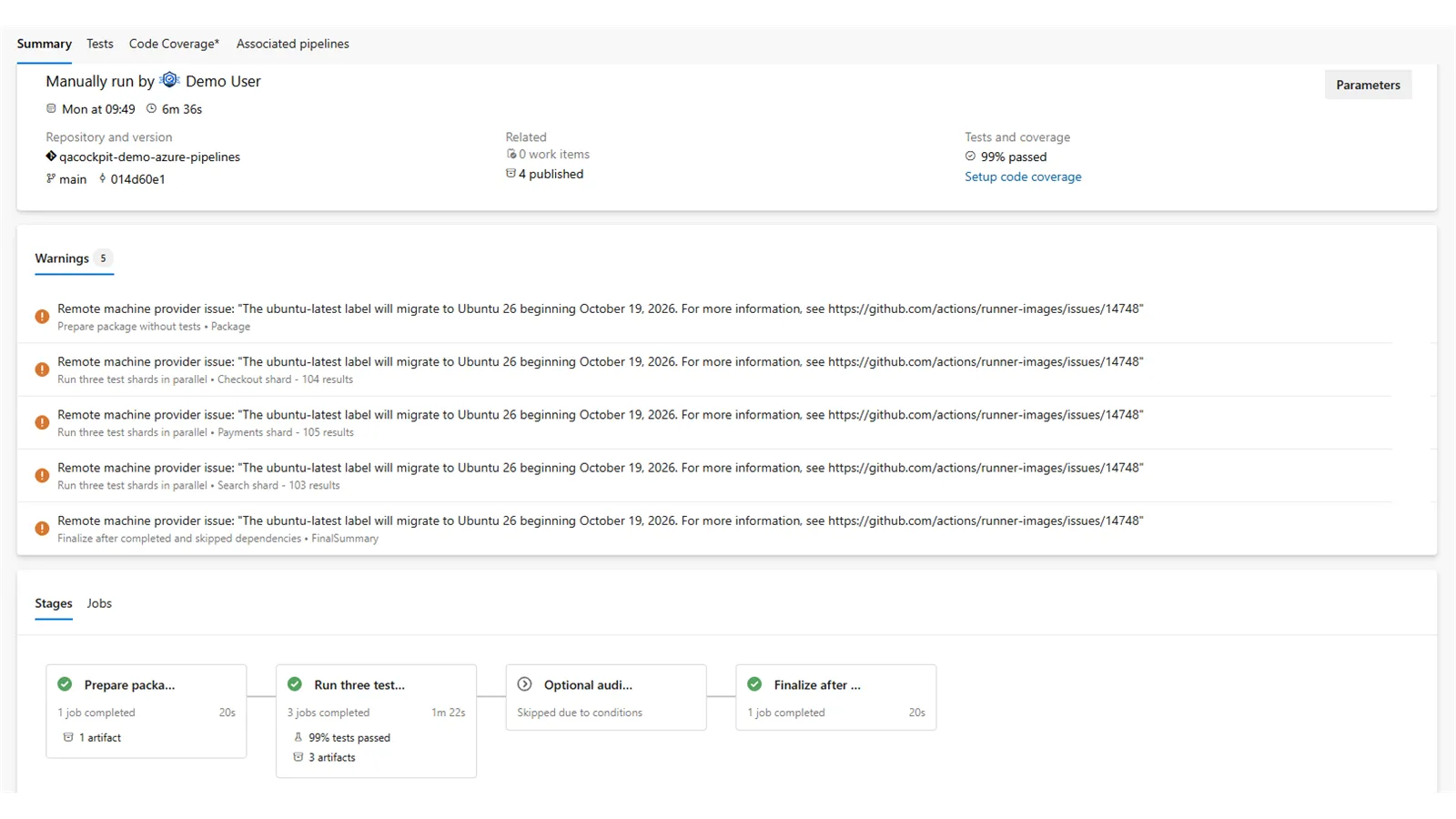
Native Azure DevOps capture of synthetic PlaneFlow run 332, captured 1 November 2026. The stage cards show structure and reported durations; they do not prove which interval is the best optimization target.
Run one measured improvement
Choose the largest confirmed interval on the critical path and change one thing:
- move a noncritical schedule away from the release peak
- narrow duplicated setup behind one documented boundary
- replace a fixed sleep with an observable condition
- balance shards by measured duration
- publish reports concurrently only if completeness remains verifiable
- retire a job only after confirming no consumer or control depends on it
Compare comparable runs and record elapsed feedback time, time to first useful failure, total agent time, retry time, and missing-result incidents. A shorter pipeline that loses required evidence is not an improvement.
The practical rule is simple: optimize the path to the decision, not the loudest task name. Queue, setup, tests, reporting, and artifacts are different problems and deserve different fixes.